Jar care guide
Why is my honey turning solid?
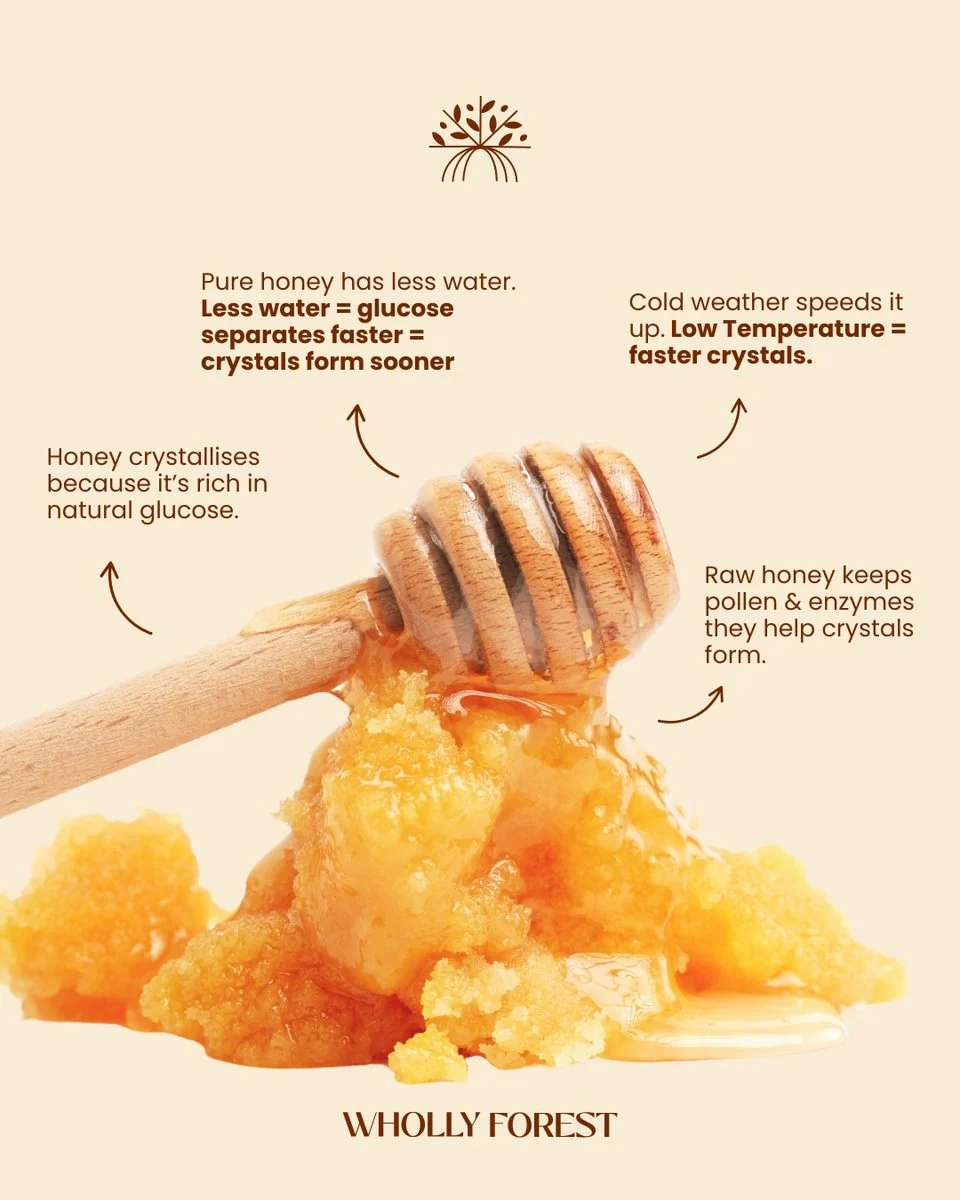
Honey can become cloudy, grainy, creamy, or firm when glucose forms crystals. That change is normal, but it is not a purity test by itself.
- 0%
- C3 and C4 syrup markers
- Under 15
- HMF in mg/kg, against an 80 limit
- 4.5
- average across 153 reviews
- 24 to 48h
- Hyderabad dispatch window
Glucose and fructose, in plain language
Honey contains glucose and fructose dissolved in a small amount of water. Glucose is less soluble, so it can leave the liquid and form crystals. Floral source, moisture, pollen, storage temperature, and time affect how quickly this happens.
Raw and ultra-filtered honey
Raw honey can retain pollen and fine particles that give crystals a place to start. Heavy filtration can remove many of those particles, and heating can delay crystallization. Still, some genuine honey remains liquid for longer. Crystallization is consistent with raw honey, not proof of purity.
How to soften a jar
- Keep the closed jar in a warm-water bath below 40°C.
- Wait 10 to 15 minutes, then stir if needed.
- Repeat gently rather than using high heat.
Do not microwave or boil the jar. Store it in a dry pantry around 20 to 25°C. Lab checks, not kitchen tests, address adulteration.
Frequently asked questions
Is crystallized honey fake?
No. Crystallization is a normal physical change in honey. It does not prove purity or adulteration on its own.
Can I microwave crystallized honey?
Do not microwave it. Use a warm-water bath below 40°C.
Should raw honey go in the refrigerator?
No. Keep it sealed in a dry pantry around 20 to 25°C.
Does crystallization prove honey is raw?
No. It is consistent with raw honey, but only appropriate lab testing can assess common adulteration markers.